Introducing Fresh:
The framework so simple, you already know it.
No config files, no build step, no node_modules. Just one file and you have a server with routing, JSX, and islands.
deno run -Ar jsr:@fresh/init
Take a tour of Fresh
Server-rendered by default
Every route renders on the server as a Preact component. Zero JavaScript hits the browser unless you opt in with an island. Pages are fast because they start as plain HTML.
export default function HomePage() {
  const now = Temporal.Now.plainDateTimeISO()
    .toLocaleString("en-US");
  return (
    <p>Freshly server-rendered {now}</p>
  );
}
Freshly server-rendered 6/2/2026, 4:54:31 PM
Interactive where it matters
Most of your page is static HTML. Islands are the small, interactive parts that get hydrated with JavaScript. You choose exactly what runs on the client.
Built on Preact and Signals, so islands are tiny and reactive out of the box.
Learn more about islandsimport { useSignal } from "@preact/signals";
export default function Counter(props) {
const count = useSignal(props.start);
return (
<div>
<h3>Interactive island</h3>
<p>The server supplied the initial value of {props.start}.</p>
<div>
<button onClick={() => count.value -= 1}>-</button>
<div>{count}</div>
<button onClick={() => count.value += 1}>+</button>
</div>
</div>
);
}Interactive island
The server supplied the initial value of 3.
Forms that just work
Handle submissions server-side with standard Request and FormData. No client-side state management, no serialization headaches. Progressive enhancement comes free.
Forms in Freshimport { createDefine } from "fresh";
const define = createDefine();
export const handler = define.handlers({
async POST(ctx) {
const form = await ctx.req.formData();
const treat = form.get("treat");
await db.votes.insert({ treat });
return new Response(null, {
status: 303,
headers: { location: "/thanks" },
});
},
});Stream HTML straight from the server
Swap chunks of HTML from the server straight into the page. No full reload, no client-side routing library. Click a link or submit a form and Fresh streams just the part that changed. Perfect for interactive elements and dynamic apps.
Learn more about Partialsimport { Partial } from "fresh/runtime";
export const Recipes = () => (
<div f-client-nav>
<aside>
<button f-partial="/recipes/lemonade">
Lemonade
</button>
<button f-partial="/recipes/lemon-honey-tea">
Lemon-honey tea
</button>
<button f-partial="/recipes/lemondrop">
Lemondrop Martini
</button>
</aside>
<main>
<Partial name="recipe">
Click a recipe to stream HTML into this spot
</Partial>
</main>
</div>
);And so much more
View Transitions
Native-feeling page transitions with a single config flag. Customize per-element with plain CSS.
const app = new App({
  viewTransition: true,
});
Route Handlers
Define GET, POST, DELETE, or any HTTP method as a named handler on your route, with full type safety.
export const handlers = define.handlers({
  GET(ctx) { /* ... */ },
  POST(ctx) { /* ... */ },
  DELETE(ctx) { /* ... */ },
});
WebSockets
Add real-time endpoints with app.ws(). Define open, message, and close handlers in a single object.
app.ws("/chat", {
  open(socket) { /* ... */ },
  message(socket, event) {
    socket.send(event.data);
  },
});
<Head> Component
Set titles, meta tags, stylesheets, and scripts from any page or island. No hoisting hacks needed.
<Head>
  <title>My Page</title>
  <meta name="description"
    content="..." />
</Head>
OpenTelemetry
Auto-injects a traceparent meta tag into every page, connecting browser traces to server spans.
const app = new App({
  otel: true,
});
Content Security Policy
Automatic nonce injection for inline scripts and styles. Strong security defaults with zero boilerplate.
app.use(csp({
  directives: {
    scriptSrc: ["'nonce'"],
  },
}));
(…and even more)
File-based routing
Drop a file in routes/, get a URL. Dynamic params via [id].tsx.
Middleware
Chain auth, logging, or any logic before your routes run.
Zero-config TypeScript
Just write .tsx. No tsconfig, no build step, it just works.
Deploy anywhere
Deno Deploy, Docker, Cloudflare Workers, or a single binary with deno compile.
Layouts
Nested layouts that compose automatically from the file system.
Built-in plugins
CORS, CSRF, IP filtering, and trailing slashes out of the box.
Built for the edge
Fresh is the secret sauce behind production-grade, enterprise-ready software like Deco.cx, Brazil's top eCommerce platform
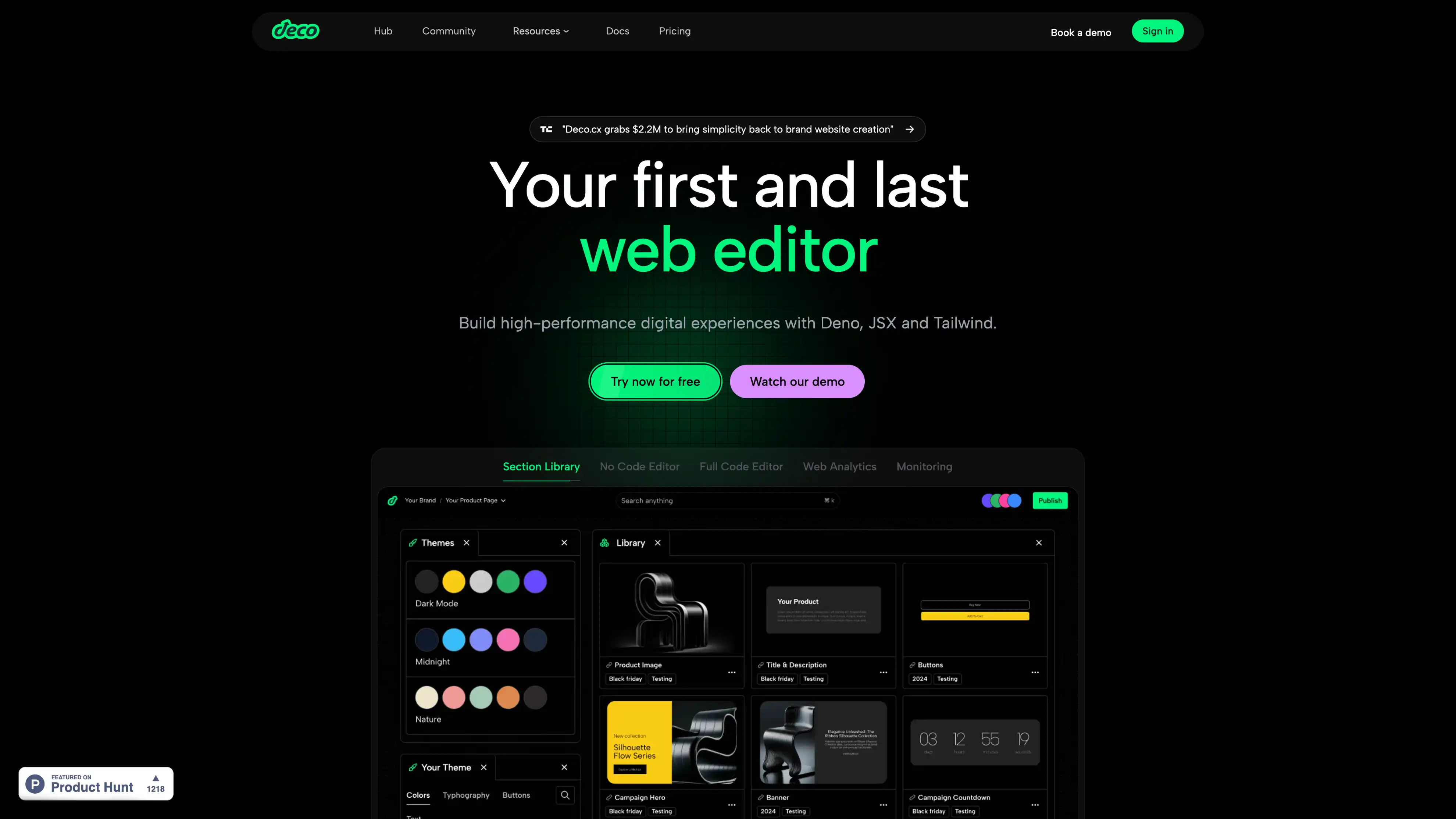
“The team also used Fresh, a next-gen Deno-native full stack web framework that sends zero JavaScript to the client, for its modern developer experience and snappy performance…
This stack unlocked 5x faster page load speeds and a 30% jump in conversion rates for their clients.”

Built on Deno
Deno is the next evolution of server-side JavaScript, with stronger security, a robust built-in toolchain, and zero-config TypeScript support. (It's faster than Node, too.)
Learn more about Deno
Time for a Fresh start
Jump right in and build your website with Fresh. Learn everything you need to know in seconds.
Get started